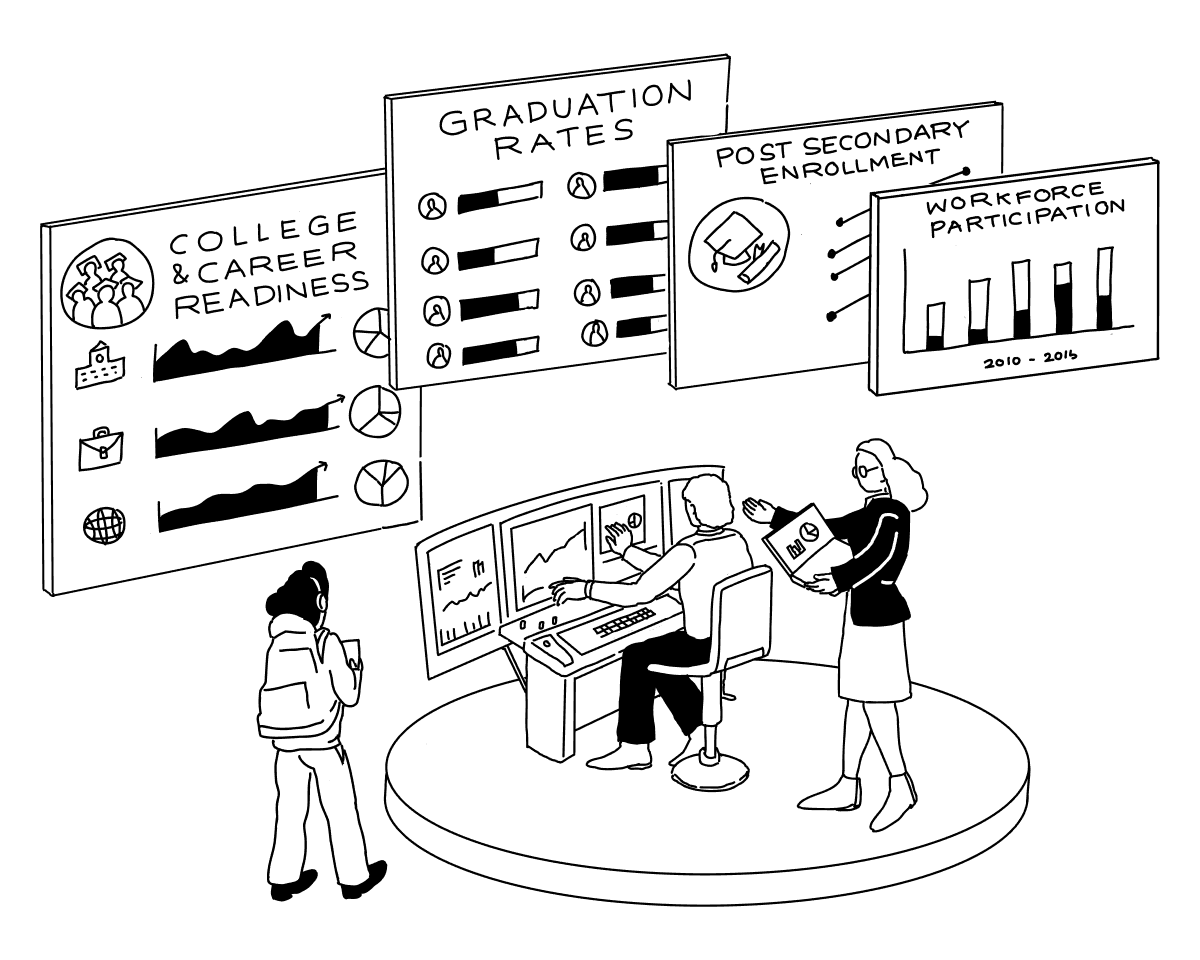
Purdue Polytechnic High School (PPHS) offers a powerful example of the importance of postsecondary success metrics. PPHS opened in 2017 with a bold mission: dramatically increase the number of Indianapolis graduates who qualify for and enroll at Purdue University. Thanks to its strong partnership with the university, PPHS knows it is delivering on that promise. By 2022, PPHS had single-handedly tripled the number of Indianapolis public high school graduates who enroll at Purdue University’s flagship campus each year.
Over time, however, school leaders have widened their focus. Is PPHS’s innovative model—centered on STEM and real-world learning—also preparing more students for higher education more broadly, and for success in well-paying careers? Fortunately, because PPHS operates in Indiana, they’re able to begin answering those questions.

In 2022, for example, 60 percent of Black PPHS graduates enrolled in college—twice the Indianapolis average of 30 percent and well above the statewide rate of 45 percent. Students from low-income families enrolled in college at a rate of 58 percent compared with 27 percent districtwide and 39 percent statewide. PPHS graduates are also keeping pace with their peers across Indiana in college success metrics like credits earned and persistence into the second year. In time, school leaders will be able to track degree completion and even employment outcomes.
PPHS leaders know they are fulfilling their promise to students and families because Indiana has built a longitudinal data system, and state agencies use that system to transparently report on how graduates progress after high school. No single high school could follow its graduates so precisely, nor could any district. In this case, it truly does take a state.
Statewide data and reporting systems don’t just benefit school leaders and staff. Families can use the data to make informed decisions about their student’s education and to advocate for additional resources or schoolwide improvements. According to one national poll, about one in three students said such school-level data would be helpful to understand whether they are prepared for their next steps after high school. Finally, these systems also inform policymakers, helping them identify changes that may be needed in order to improve the quality of a state’s education system and the life outcomes of its students.
To meet the criteria for this policy action, a state must:
Transparently and publicly report, for each high school, disaggregated data on graduates’ enrollment and progress in postsecondary education. Progress could include data on success during the first year of college, persistence beyond the first year of college, or graduation from college.
Excellence looks like: every leader, family, and student knowing whether schools are delivering on the promise of preparation. Real-time, transparent data gives state leaders the insight they need to act—and the tools to ensure continuous improvement.
Download the How to Be a Frontier for State Excellence Guide here