10 State

Policy Actions

10 State

Policy Actions

Policy Action
1

Postsecondary Credits

Ensure universal access to advanced coursework that can lead to college credit

Policy Action
1

Postsecondary Credits

Ensure universal access to advanced coursework that can lead to college credit

Policy Action
1

Postsecondary Credits

Ensure universal access to advanced coursework that can lead to college credit

Overview
Overview
Overview

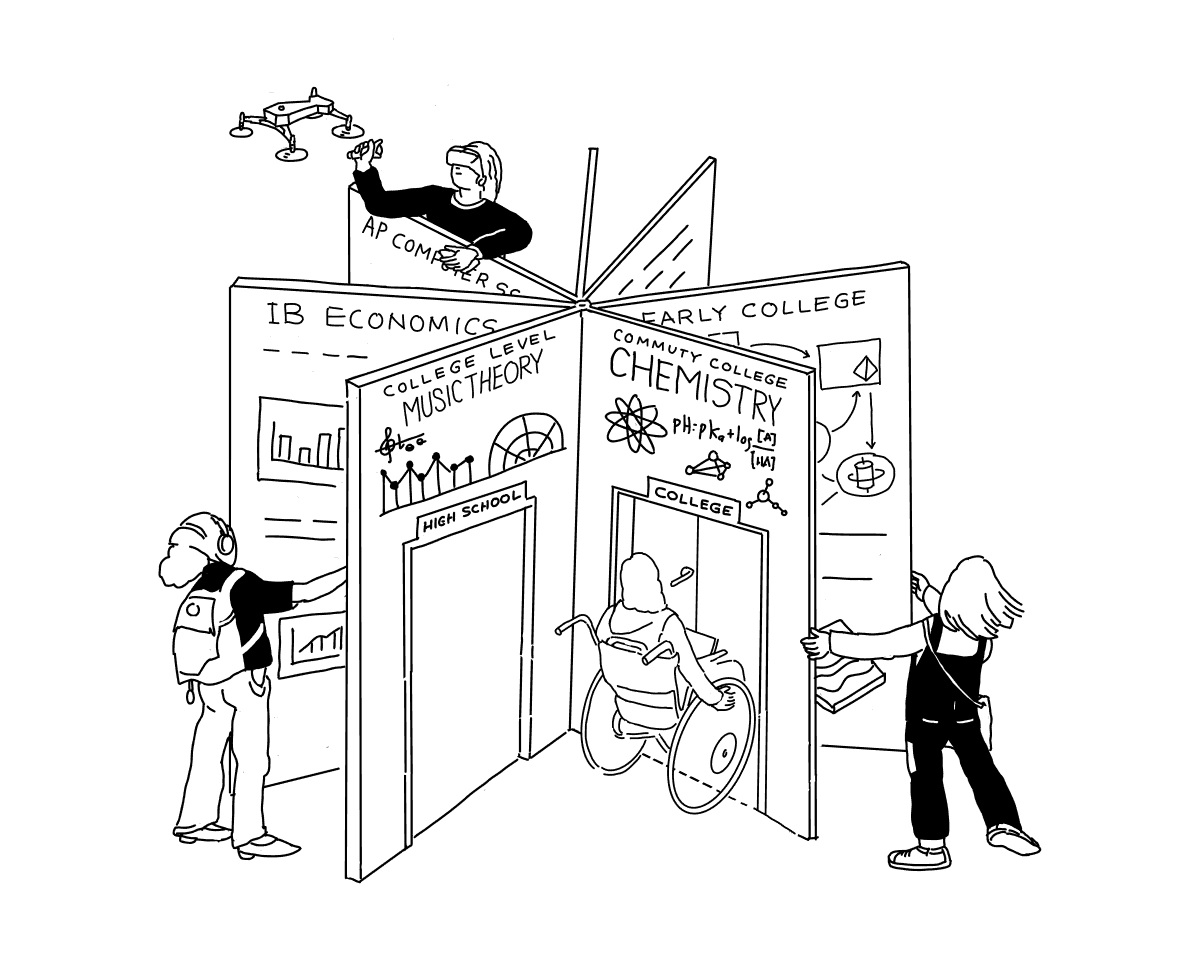
High schools should be springboards of opportunity, ensuring that postsecondary education and training is available to every student. Beyond aligning diploma requirements with public college admissions criteria (Policy Action 3), states can expand opportunity by offering all students access to advanced, college-level coursework that allows them to earn postsecondary credits while still in high school. That can include, for example, Advanced Placement (AP), International Baccalaureate (IB), dual enrollment or dual credit, and postsecondary CTE-focused courses.

Studies show that taking even one advanced class predicts positive outcomes later in life, including college-going, choice of college major, and lower student loan debt—all of which in turn predict greater success in the labor market. The benefits begin in high school: According to the Education Trust, “When students have access to advanced coursework opportunities, they work harder and are more engaged in school, have fewer absences and suspensions and higher graduation rates.” Finally, students who earn postsecondary credits in high school can use them to reduce college tuition costs and shorten the time it takes to earn a degree.

Advanced coursework can support career readiness as well. In Washington State, for example, the CTE Dual Credit program allows students to earn college-level credit in high school through industry-aligned courses that blend rigorous academics with technical and workplace skills. These credits can be applied at any community or technical college in the state.

Despite these benefits, many students still don’t have access to such opportunities. Only 72 percent of high school students say their school offers advanced coursework for earning postsecondary credit. Among parents with children who are not enrolled in a dual enrollment course, 73 percent said they’d like their child to enroll in one—an “unmet demand” seen across all income levels.

National data have long shown that access to advanced courses varies across different kinds of high schools. A survey conducted in 2025 revealed that 79 percent of high schools serving relatively few students of color offer advanced courses of some kind, compared with 67 percent of high schools enrolling a high percentage of such students.

Every student deserves a fair chance to challenge themselves, work hard, and get a head start on postsecondary credits and lifelong success—which is exactly what advanced coursework is all about.


Criteria
Criteria
Criteria

To meet the criteria for this policy action, a state will require that:


  1. All high schools offer advanced coursework that enables students to earn college credit, or it will


  2. Directly offer statewide access to advanced coursework options either in-person or virtually


Excellence looks like: advanced coursework is available to every student, in every community—no exceptions—with the supports students and teachers need to succeed. Today’s technology makes this goal more in reach than ever before, including adaptive assessments so that we can pinpoint what high school students need to catch up.

Download the How to Be a Frontier for State Excellence Guide here

The National Landscape

Every state and D.C. meets the criteria for at least one policy action.

The National Landscape

Every state and D.C. meets the criteria for at least one policy action.

Texas

is leading the way

Policy makers in Texas have established a solid foundation for high school transformation through efforts to support college and career readiness for every student across the state. To that end, the state has adopted policies to align high school diplomas to college entrance requirements (Policy Action 3) while providing high school students with opportunities for advanced coursework and work-based learning. Texas law requires all school systems to offer students the opportunity to earn 12 or more semester hours of college credit through different course options, including dual enrollment, AP, and IB.1 Eligibility is open to all students enrolled in high school who meet the prerequisite course requirements. Dallas ISD has proven to be an exemplar in increasing dual credit experiences for Black, Latino, and economically disadvantaged students and outpacing the state average. In the 2022-23 school year, 873 high school students earned associate degrees (60+ credit hours), and the dual credit success rate rose to 79%-a jump of nearly 7% from the previous year.

Washington

is leading the way

Washington is a national leader in transforming high school education through its focus on mastery-based learning and expanding access to advanced coursework. In the class of 2023, 90% of graduates completed at least one dual credit course (including AP, 1B, postsecondary CTE, or other postsecondary-level coursework). In 2011, the legislature passed a policy requiring every high school to work towards the goal of offering enough advanced courses to enable students to earn a full year's worth of postsecondary credits before graduation. The policy also requires schools to inform students and their families about the opportunity and encourage students to consider 12th grade a "launch year" to get a head start on their postsecondary education and career preparation. In addition, in 2019, Washington became the first in the nation to adopt a policy that requires all eligible students to be automatically enrolled in advanced coursework unless they actively decline to participate. A recent study of the policy-dubbed Academic Acceleration-found that it increases enrollment in advanced coursework, especially for students who traditionally are less likely to take such courses, without negatively impacting students' grades.

Texas

is leading the way

Policy makers in Texas have established a solid foundation for high school transformation through efforts to support college and career readiness for every student across the state. To that end, the state has adopted policies to align high school diplomas to college entrance requirements (Policy Action 3) while providing high school students with opportunities for advanced coursework and work-based learning. Texas law requires all school systems to offer students the opportunity to earn 12 or more semester hours of college credit through different course options, including dual enrollment, AP, and IB.1 Eligibility is open to all students enrolled in high school who meet the prerequisite course requirements. Dallas ISD has proven to be an exemplar in increasing dual credit experiences for Black, Latino, and economically disadvantaged students and outpacing the state average. In the 2022-23 school year, 873 high school students earned associate degrees (60+ credit hours), and the dual credit success rate rose to 79%-a jump of nearly 7% from the previous year.

Washington

is leading the way

Washington is a national leader in transforming high school education through its focus on mastery-based learning and expanding access to advanced coursework. In the class of 2023, 90% of graduates completed at least one dual credit course (including AP, 1B, postsecondary CTE, or other postsecondary-level coursework). In 2011, the legislature passed a policy requiring every high school to work towards the goal of offering enough advanced courses to enable students to earn a full year's worth of postsecondary credits before graduation. The policy also requires schools to inform students and their families about the opportunity and encourage students to consider 12th grade a "launch year" to get a head start on their postsecondary education and career preparation. In addition, in 2019, Washington became the first in the nation to adopt a policy that requires all eligible students to be automatically enrolled in advanced coursework unless they actively decline to participate. A recent study of the policy-dubbed Academic Acceleration-found that it increases enrollment in advanced coursework, especially for students who traditionally are less likely to take such courses, without negatively impacting students' grades.

Texas

is leading the way

Policy makers in Texas have established a solid foundation for high school transformation through efforts to support college and career readiness for every student across the state. To that end, the state has adopted policies to align high school diplomas to college entrance requirements (Policy Action 3) while providing high school students with opportunities for advanced coursework and work-based learning. Texas law requires all school systems to offer students the opportunity to earn 12 or more semester hours of college credit through different course options, including dual enrollment, AP, and IB.1 Eligibility is open to all students enrolled in high school who meet the prerequisite course requirements. Dallas ISD has proven to be an exemplar in increasing dual credit experiences for Black, Latino, and economically disadvantaged students and outpacing the state average. In the 2022-23 school year, 873 high school students earned associate degrees (60+ credit hours), and the dual credit success rate rose to 79%-a jump of nearly 7% from the previous year.

Washington

is leading the way

Washington is a national leader in transforming high school education through its focus on mastery-based learning and expanding access to advanced coursework. In the class of 2023, 90% of graduates completed at least one dual credit course (including AP, 1B, postsecondary CTE, or other postsecondary-level coursework). In 2011, the legislature passed a policy requiring every high school to work towards the goal of offering enough advanced courses to enable students to earn a full year's worth of postsecondary credits before graduation. The policy also requires schools to inform students and their families about the opportunity and encourage students to consider 12th grade a "launch year" to get a head start on their postsecondary education and career preparation. In addition, in 2019, Washington became the first in the nation to adopt a policy that requires all eligible students to be automatically enrolled in advanced coursework unless they actively decline to participate. A recent study of the policy-dubbed Academic Acceleration-found that it increases enrollment in advanced coursework, especially for students who traditionally are less likely to take such courses, without negatively impacting students' grades.

What you can do

Resources

As a starting point, align graduation requirements with eligibility for public institutions of higher education (Policy Action 3).
Identify opportunities to increase the number of students eligible for advanced coursework.
Help establish multiple options for college-level coursework that can earn students postsecondary credit.

What you can do

Resources

As a starting point, align graduation requirements with eligibility for public institutions of higher education (Policy Action 3).
Identify opportunities to increase the number of students eligible for advanced coursework.
Help establish multiple options for college-level coursework that can earn students postsecondary credit.

What you can do

Resources

As a starting point, align graduation requirements with eligibility for public institutions of higher education (Policy Action 3).
Identify opportunities to increase the number of students eligible for advanced coursework.
Help establish multiple options for college-level coursework that can earn students postsecondary credit.
Keep Exploring

Keep Exploring

Keep Exploring

© 2025 XQ Institute

Privacy Policy

Terms of Use

About XQ

© 2025 XQ Institute

Privacy Policy

Terms of Use

About XQ

XQ Chat

December 17, 2025

Loading Policy Chat...

XQ Chat

December 17, 2025

Loading Policy Chat...